

California
California Department of Motor Vehicles
California permit practice test
Free practice for the California DMV knowledge test — no account, no paywall. Every answer explains why and links to the rule it comes from, and 15 questions are checked against California's own handbook.
- Earliest permit
- 15½
- Test
- —
- Pass mark
- 80%
— = not confirmed. Sources in the facts section below.
Practice for the California knowledge test
103 questions available · free · no account · progress stays on this device
Loading your saved progress…
California licensing facts we could verify
Each fact names its source and how we read it. Where an agency doesn't publish a detail, or blocked our checker, we say so instead of guessing.
- Licensing agency
- California Department of Motor Vehicles
- Earliest learner permit
- 15½Read on the official page · Instruction and Learner's Permits · checked October 12, 2026
- Knowledge test format
- 80% to passThe DMV page gives the pass mark but not the number of questions.Read on the official page · Instruction and Learner's Permits · checked October 12, 2026
- Official test online?
- Not confirmedThe permit page describes in-office testing; we did not confirm current online-test eligibility.
Official handbook
California Driver's Handbook ↗We read this edition page by page on October 12, 2026 to check the California-specific questions here. It is the source of truth — study it.
California Driver's Handbook © California DMV, licensed CC BY-NC 4.0. Commercial reuse needs written permission, so we link to it and do not reprint it.
Ready for the real thing?
Appointments, documents and fees are set by the California Department of Motor Vehicles. Always book through the official site.
Go to the California DMV site ↗Specific to California
Rules that differ from state to state
These come straight from the California Driver's Handbook, page referenced — and several are numbers other states set differently.
At an all-way (four-way) stop, the driver who arrives and stops first goes first.
Handbook p. 45
At an all-way stop, when two vehicles arrive at the same time, the driver on the left yields to the driver on the right.
Handbook p. 45
When an emergency vehicle approaches using its siren and/or flashing lights, drive to the right edge of the road and stop until it has passed (never stopping inside an intersection).
Handbook p. 51
On a road without a median or barrier, traffic in both directions stops for a school bus that is stopped with its red lights flashing.
California also excuses oncoming traffic on multilane highways with two or more lanes each way.
Handbook p. 57
Do not park within 15 feet of a fire hydrant.
Handbook p. 34
Switch to low beams when an oncoming vehicle is within 500 feet.
Handbook p. 17
Use low beams when following another vehicle within 300 feet.
Handbook p. 17
Headlights on from 30 minutes after sunset until 30 minutes before sunrise.
Handbook p. 17
Drivers 21 and over: the per se alcohol limit is 0.08% BAC.
Handbook p. 79
Drivers under 21: the limit is 0.01% BAC.
Handbook p. 79
Teens log at least 50 hours of supervised driving before a provisional license.
Handbook p. 9
Signal at least 100 feet before turning.
Handbook p. 17
When stopping for a train, stop no closer than 15 feet to the nearest rail.
Handbook p. 57
Leave at least 3 feet when passing a bicyclist.
Handbook p. 54
Do not park within 20 feet of a crosswalk at an intersection.
California: 15 feet where a curb extension is present.
Handbook p. 34
RoadSense Studio
See the situation, then decide
Step through real intersections. Only scenes whose rule we verified for California (or that rest on the national standard) appear here.
California · verified scene
Four-way stop: a tie
Know who goes first when two drivers stop at the same moment.
Approaching. You drive north toward an all-way stop. A blue car approaches from the east — on your right.
Rule: At an all-way stop, when two vehicles arrive at the same time, the driver on the left yields to the driver on the right.
- California Driver's Handbook — p. 45
Read the whole scene as text
- Approaching: You drive north toward an all-way stop. A blue car approaches from the east — on your right.
- Both stopped: You and the blue car come to a full stop at your stop lines at the same moment.
- Right goes first: The blue car, on your right, proceeds through the intersection. You wait.
- Your turn: Once the blue car has cleared, you go.
Sample questions
Answers and sources are in the page, so they work without JavaScript.
Sample 1 · California rule
California: you stop at a four-way stop. Two cars reach their stop signs a few seconds after you. Who should go first?
- You, because you stopped first
- The car on your right
- The car going straight
- The largest vehicle
Show answer
You, because you stopped first. At an all-way stop, drivers go in the order they arrived and stopped.
Source: California Driver's Handbook, p. 45
Sample 2 · California rule
California: you and a car on your right stop at a four-way stop at the same moment. Who goes first?
- You — you are on the left
- The car on your right
- Whoever is turning left
- Whoever honks first
Show answer
The car on your right. When two drivers arrive at the same time, the driver on the left yields to the driver on the right.
Source: California Driver's Handbook, p. 45
Sample 3 · National standard
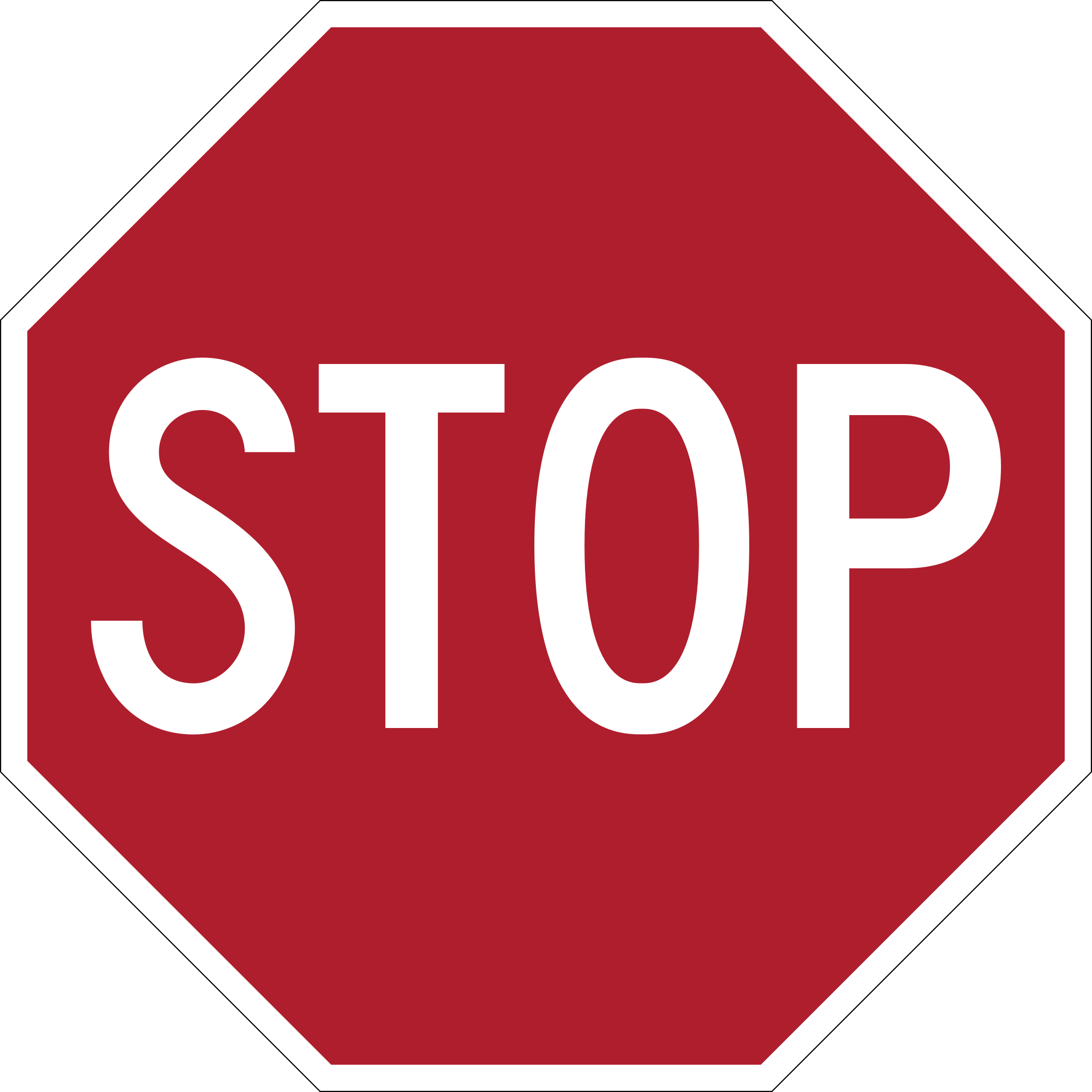
What does this sign require you to do? (Red octagon STOP sign)
- Slow down and continue if no one is coming
- Come to a full stop, then go only when it is safe
- Stop only if other vehicles are at the intersection
- Stop only when turning
Show answer
Come to a full stop, then go only when it is safe. An octagon is used for STOP and nothing else. It is placed where a full stop is always required, so you stop completely every time, then proceed only when you can do so safely.
Source: Manual on Uniform Traffic Control Devices for Streets and Highways, 11th Edition with Revision 1, Section 2B.04; Table 2A-1
Where this page stands
- State facts not yet reviewed by a human editor
Common questions
California permit test, answered
How many questions are on the California permit test, and what do I need to pass?
The California DMV publishes: 80% to pass. The DMV page gives the pass mark but not the number of questions. Source: Instruction and Learner's Permits.
How old do you have to be to get a learner permit in California?
15½. Source: Instruction and Learner's Permits.
Can I take the official California knowledge test online?
Not confirmed — The permit page describes in-office testing; we did not confirm current online-test eligibility. Our practice is online, but it is not the official test.
Is this the official California DMV test?
No. FuelWide is independent. Our 103 practice questions are written by us, 15 of them from rules we checked in the California handbook, and the official test is given only by the California Department of Motor Vehicles.
What does the California test cover?
Every state tests road signs, signals and pavement markings (a national standard), right-of-way, and safe-driving practice, plus its own laws — parking distances, alcohol limits, school-bus and emergency-vehicle rules. The California Driver's Handbook is the source of truth.
More for new California drivers
- Road sign trainer — every standard U.S. sign shape and color
- California gas prices — what filling up costs today
- Fuel cost calculator — budget your first car's running costs
FuelWide Driving Academy is independent. It is not affiliated with, endorsed by or run by any state motor vehicle agency or government body, and its practice sets are not the official knowledge test. Book and take the real test only through the California Department of Motor Vehicles.